Green wave taxonomy studies
Reading and understanding of internal and public documents recently produced by CV aiming at a better understanding of the ecosystem of green solutions in Brazil.
A snapshot of the Brazilian green innovation ecosystem, providing statistical analysis, trends and recommendations for its development
Explore
The Onda Verde 2024 Ecosystem Map is the second publication in the Onda Verde Insights collection and aims to provide a snapshot of the Brazilian green economy ecosystem, bringing statistical analyses and insights for its development.
The study seeks to map the current stage of the green ecosystem in Brazil, exploring opportunities and demands to strengthen a sustainable economy. Conducted using data from the Onda Verde Platform, the report combines quantitative and qualitative analyses of 928 organizations , highlighting the needs and challenges for green innovation.
These are the partners who supported the national call for mapping the Onda Verde Insights collection:
This work aims to:

Provide the market with statistical analyses on the actors that make up the green economy, such as the number of organizations offering green solutions, their sectors of activity and their demands.

Provide estimates of the volume of capital available to finance solutions and businesses with socio-environmental and climate impact, compared to the volume of capital required by these initiatives.

Provide support, through quantitative and qualitative analyses, to guide the development of public policies aligned with Brazil's Nationally Determined Contribution (NDC) and the Climate Plan. In addition, promote mechanisms to support green businesses.
Reading and understanding of internal and public documents recently produced by CV aiming at a better understanding of the ecosystem of green solutions in Brazil.
Through the Onda Verde Platform and its collaborative networks, the entire ecosystem of organizations operating in the green economy was invited to answer an online, self-declared questionnaire, with up to 90 questions aimed at understanding the organizations, roles, offers, demands and challenges.
Based on reading the structures of the study A ONDA VERDE and the analyses of questionnaires from the Environmental Impact Business Map, carried out by Pipe.Social, and the Impact Base (Pipe.Social + Quintessa), a form was created by many hands that structured the call for mapping the national ecosystem of green solutions.
15 in-depth interviews, lasting 1 hour, were conducted with national and international experts on the topics of the green economy, climate, the Brazilian market and impact businesses.
The database used for this Map was the Onda Verde Platform, totaling 928 organizations. Of these, 493 responded to the Onda Verde Mapping, providing additional data on diversity in the profile of leaders, measurement of impact and volume of funding requested and/or offered. All information was organized and analyzed by a specialized team to produce the highlights, insights and trends in this report.
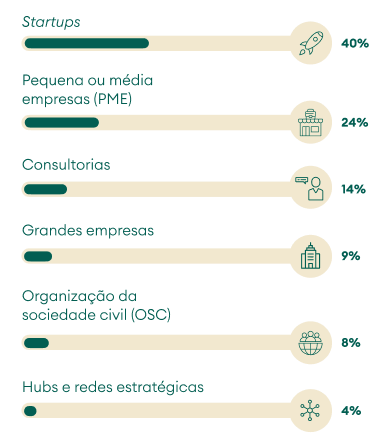
Section intended for the general characterization of the ecosystem, based on data from the 928 organizations that updated their profiles on the Onda Verde Platform from August 2023 to October 2024. With this, we are able to understand information such as:
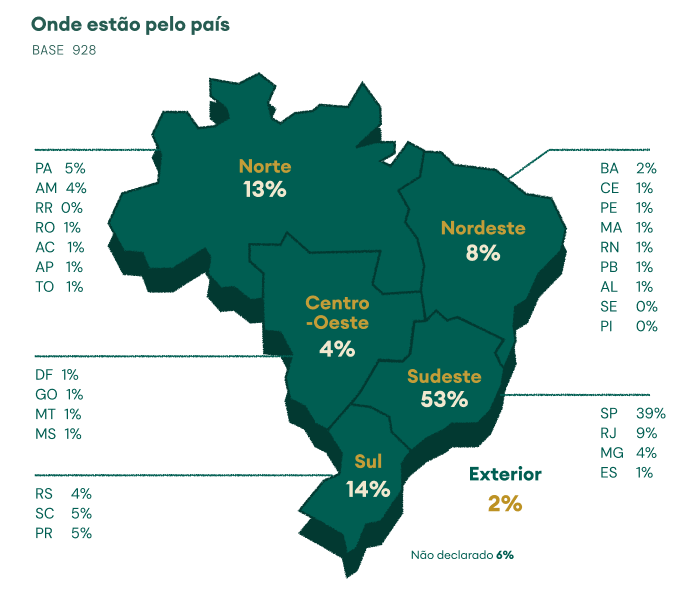
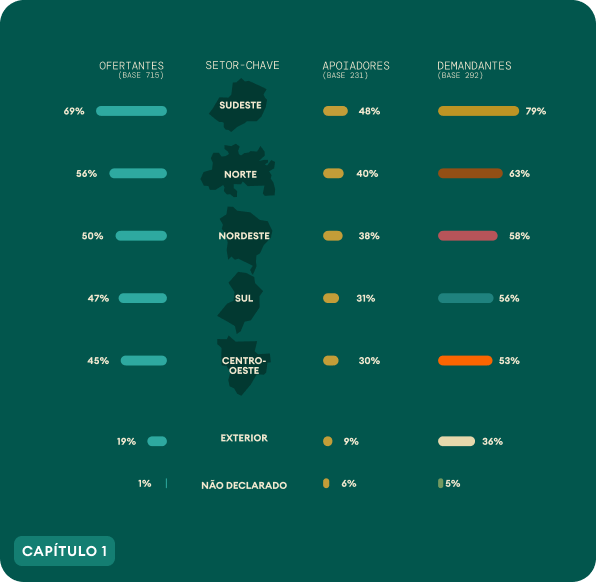
53% of the organizations in the sample are concentrated in the Southeast , especially in São Paulo, where there is a greater supply of financial resources and institutional support. However, the North, with the Amazon region and especially the state of Pará, represents an important part of the ecosystem, evidencing the growth of the bioeconomy and the growing interest in the area.
“COP30 puts Brazil at the center of global climate attention, and we have the chance to prove that we are more than just a stage for debates: we can lead. Since the country, with 92% of global GDP, adopted the net-zero emissions target, enormous potential has opened up for innovation in strategic sectors — from the largest emitters, such as land use and agriculture, to waste and the bioeconomy. For these opportunities to materialize, we need to accelerate the green innovation ecosystem…
First, connect the actors in this ecosystem to patient and even concessional capital, for example, the Climate Fund. With R$10 billion available, the Climate Fund has the potential to quickly reach high-impact initiatives, prioritizing technology and practical solutions for the bioeconomy and energy transition. Transparency and agility in transfers are crucial to transform potential into results.
Second, look to the North. The Amazon bioeconomy cannot be just talk. The Amazon states are already leading players in public policy solutions and experiences, but they need to align tax incentives and prioritize infrastructure that supports startups and sustainable businesses. The region has everything it needs to attract global investors and stand out as an innovation hub at COP30.
Finally, transform COP30 into a showcase for Brazilian solutions. Local businesses need direct support to connect with international markets and show that Brazil does not just talk, but delivers. Climate leadership is about taking action, and Brazil has what the world wants: innovation, nature and the chance to be a real catalyst in the green and resilient transition.”

In this section, we delved into data from 493 organizations in the ecosystem that, in 2024, answered questions related to financial data, available resources and diversity. The analysis deals with the data, as well as listening to industry experts who provided us with insights into the dynamics of supply, demand and trends for green solutions.
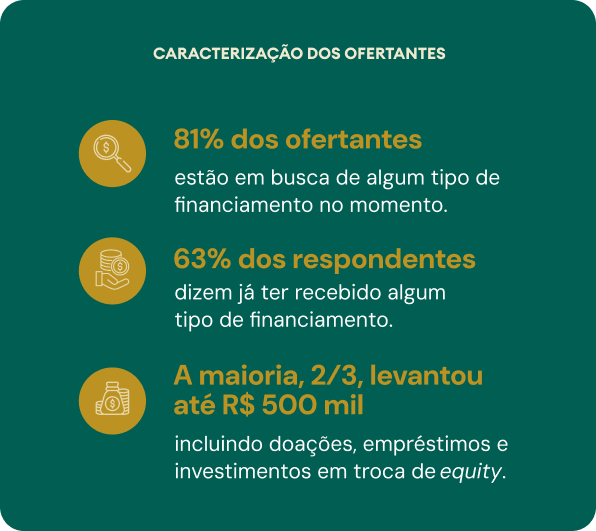
81% of organizations indicate a need for financial support , with a preference for grants, and a significant gap for lines of credit and venture capital.
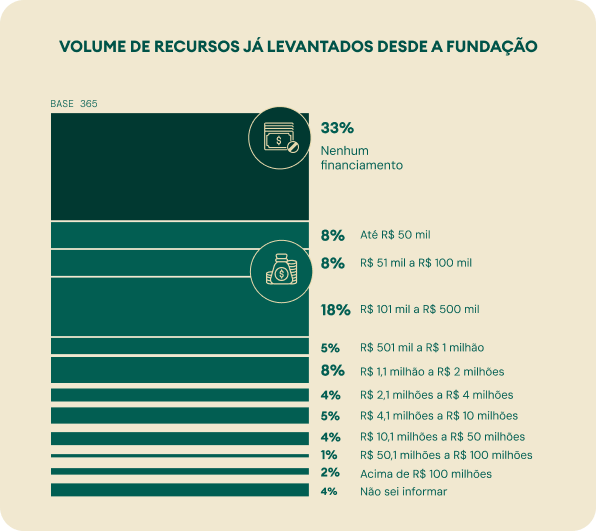
IMPORTANT : The financing data collected takes into account organizations that consider themselves to be solution providers, which include not only businesses and cooperatives, but also ecosystem promoters, consultancies and other models of organizations that raise large amounts of resources and have solution offering arms.
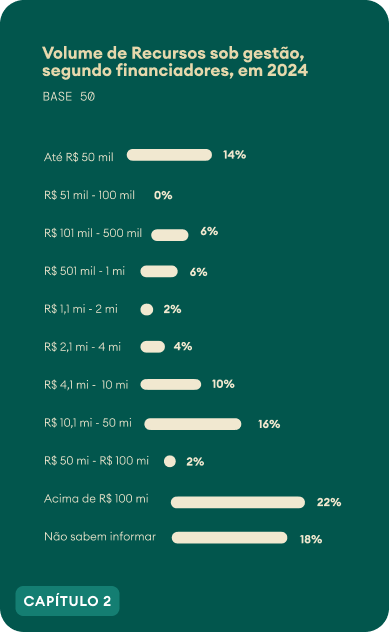
their structure or pass these resources on to those operating at the frontline. Analyzing the financing volumes above R$100 million, we observe many of these profiles. On the other hand, the 33% that have never raised funds are, for the most part, startups and SMEs
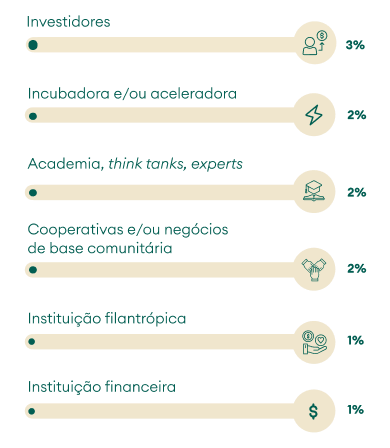
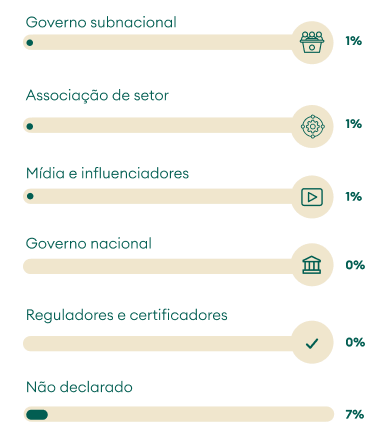
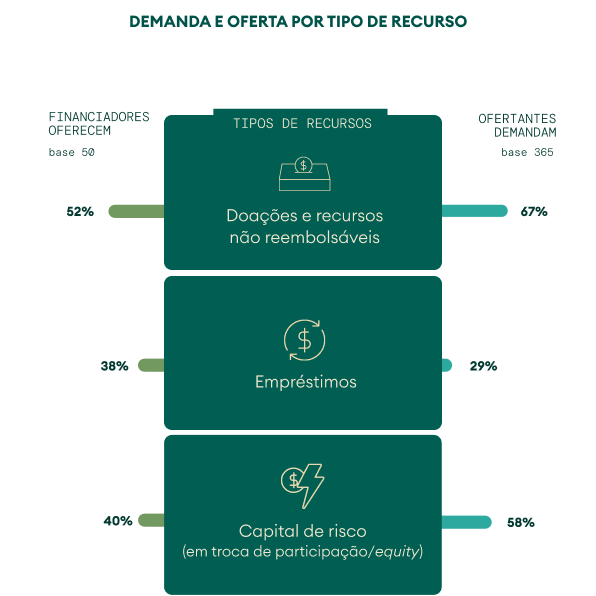
In an in-depth analysis of the data, it is possible to make some interpretations between the demand of providers by type and volume of resources versus what the financiers are offering in the market. On the one hand, most of the actors in the ecosystem seem to expect to raise money or finance solutions through donations (67%, providers; 52%, financiers) . There is more disparity between the desire of financiers to work with loans (38%) and the demand of the providers (29%) .
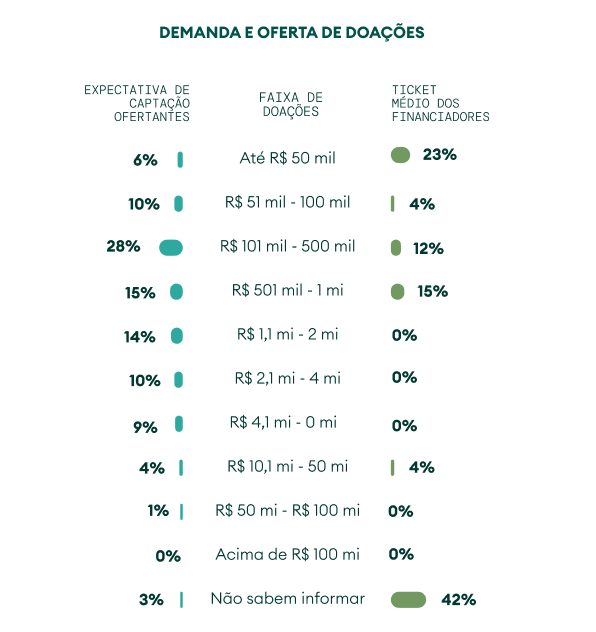
42% of investors do not declare their average ticket size . This indicates a lack of transparency regarding average donation values, which limits the convergence between available resources and the needs of green solutions.
“The biggest obstacles to scaling up financing for green solutions are the quantitative incorporation of environmental and social factors into market analyses. The awareness process has already taken place and has been successful – much of the sector recognizes these factors. However, transforming them from qualitative to quantitative is still a challenge that creates barriers to integrating them into business models and strategies….
Furthermore, there is a challenge in the formation of human capital. The financial market still has a homogeneous profile in terms of academic background and training, which makes it difficult to absorb interdisciplinary knowledge. We have few climatologists, environmental engineers or forestry professionals working directly in financial operations, which makes it harder to incorporate these factors in a structured manner.
Another crucial obstacle is the lack of appropriate technology to quantify climate and natural risks. There are still no robust methodologies that reflect the impact of rising temperatures on assets and infrastructure, preventing the appropriate pricing of these risks. If this were resolved, the cost of capital would naturally reflect the socio-environmental performance of assets, favoring those with greater resilience to climate change.”

“Accelerating the transition to a green economy is a matter of economic and environmental survival.
Climate innovation is the driving force behind this transformation, but for this process to gain scale, qualified knowledge is essential…
… Investors and companies need clear information about the opportunities and risks of this new scenario. Without solid data, it is not possible to allocate resources efficiently, identify scalable solutions or ensure that climate innovations reach their full potential. Brazil, with its vast potential in bioeconomy and nature-based solutions, is in a position to lead this global movement. But to do so, it is essential to foster access to knowledge and market insights that guide this transition in an agile and safe way.”
 Join the Green Transformation
We invite all actors in the green economy ecosystem to join us on this journey, collaborating to propel Brazil to global leadership in the just transition to a regenerative and sustainable economy.

Daniel Contrucci
Richard Gravina
Out Lottfi
Amanda Magalhães
Jacqueline Nichi
Mariana Fonseca
Rafael Oliveira
André Albuquerque Sant'Anna, Felipe Vignoli, José Pugas, Liz Lacerda, Lucas Ramalho, Lygia Anthero, Maria Laura Florido, Natalie Unterstell, Osmar Bambini and Pedro Zanetti
Fabio Issao
Thais Felix
Peter Correia
Rainete Sampaio
Caio Couto
Tania Lins
Luiz Teodoro de Souza
We work in collaboration with organizations and institutions committed to the climate agenda and sustainable development, including:

These partners play a crucial role in the development and implementation of the solutions and analytics presented by OV Insights.