Key sectors
Strategic areas of the economy that have a major environmental and social impact, in which interventions can generate significant reductions in greenhouse gas emissions and promote sustainability.
A guide to analyzing and acting in the green economy in Brazil, highlighting its growth potential.
Explore

“This study aims to be a reference material for investors, public policy makers and organizations seeking to understand and influence the green market in Brazil.”

The Green Wave Taxonomy is the heart of the Green Wave Insights project. It was developed as a pioneering framework to classify and promote sustainable economic activities in Brazil, aligning the country with net-zero emissions targets by 2050.
Inspired by international models such as the taxonomies of the European Union and Colombia, the Green Wave Taxonomy offers a “dictionary” of solutions that benefit the environment and climate, attracting public and private investment. With this tool, companies, governments and investors can identify sectors and activities that directly contribute to decarbonization, efficient use of resources and the promotion of sustainability.
Strategic areas of the economy that have a major environmental and social impact, in which interventions can generate significant reductions in greenhouse gas emissions and promote sustainability.
Innovations and practices that address environmental and social issues within key sectors.
Integrative perspectives applied to the development and implementation of solutions, ensuring that approaches are inclusive, equitable and holistic.
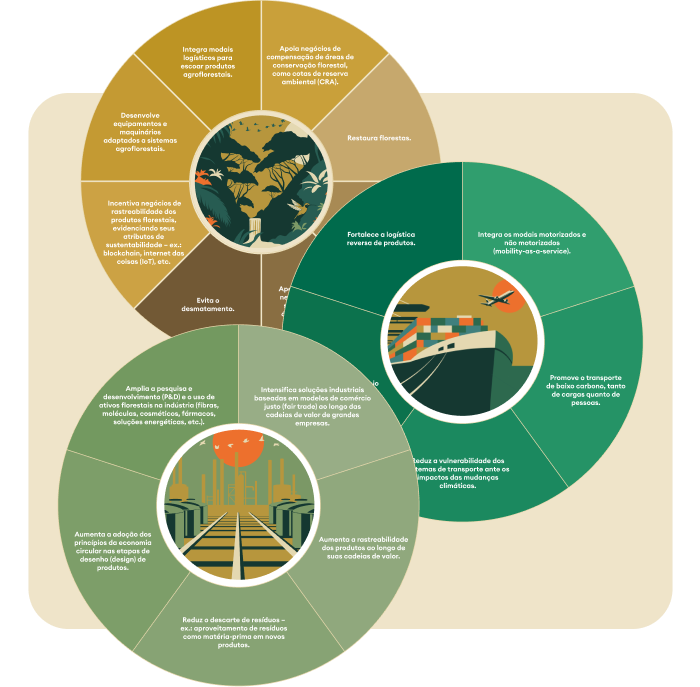
For each of the key sectors , it is understood that there is a non-exhaustive set of core activities that contribute to advancing the climate innovation and sustainability agenda, with their respective levels of maturity.
In this review, and based on the most recent developments in the climate commitment, the available technology, as well as the market involved, 8 more activities were added to the 40 initially mapped, totaling 48 across all 8 key sectors.
In addition to expanding the activities considered, new cross-cutting lenses were adopted to bring natural and social capital to the center of business strategies . Cross-cutting lenses were considered to bring social, natural and economic sensitivities to the center of green economy analysis, reflecting the interdependence between environmental sustainability, social equity and economic viability.
The inclusion of these lenses, such as Climate Justice, Nature-Based Solutions (NBS) and Traceability, was motivated by Climate Ventures' experience in interacting with more than 4,500 organizations since 2018 , understanding that the transition to a low-carbon economy requires the incorporation of practices that promote social inclusion, environmental regeneration and new sustainable value chains in all sectors.

It aims to provide goods and services while restoring soils, increasing biodiversity, absorbing carbon and improving water availability.

It integrates ethical and equity aspects, ensuring a fair transition to a low-carbon economy, with the inclusion of vulnerable groups.

Focus on physical, mental and social well-being, with equity in access to health resources and mitigation of environmental risks.

It involves the use of renewable biological resources to produce food, technological materials and energy, promoting new value chains.

Ability to monitor the origin and changes in a product throughout its production chain, ensuring resilience and efficiency.

It seeks solutions that reduce environmental impact, such as the use of sustainable inputs and efficient management of resources and waste.

It is based on eliminating waste and pollution, keeping products and materials in use and regenerating natural systems.

Use of emerging technologies such as AI, Big Data, IoT and Blockchain, to face socio-environmental challenges and promote sustainable innovation.

They play a crucial role in regulating the climate and providing resources such as energy and food.

Integrates natural processes into human activities for mitigation and adaptation to climate change.

Action and policies to reduce the negative impact of environmental and climate change, protecting the environment and communities.

Urban development and sustainable digital transformation, with collaborative governance and information technologies.

Strategies to adjust ecosystems and infrastructures to the consequences of climate change, promoting resilience.
The Green Wave Taxonomy can be applied by a diverse set of organizations collaborating to drive a regenerative, low-carbon economy.

Startups, cooperatives and other organizations that develop products and services aligned with sustainability principles can use the Taxonomy to position themselves strategically and access green funds.

Corporations, funds and other entities seeking to incorporate and/or finance sustainable products and technologies can use this study to guide their market strategies and structure their portfolios.

Incubators, government agencies and other facilitators can use the Taxonomy to guide new actions, policies and recommendations that catalyze green innovations.
 Join the Green Transformation
We invite all actors in the green economy ecosystem to join us on this journey, collaborating to propel Brazil to global leadership in the just transition to a regenerative and sustainable economy.
Daniel Contrucci
Out Lottfi
Richard Gravina
Jacqueline Nichi
Amanda Magalhães
Fabio Issao
Guilherme Sato
Syntropics
Talk Institute
Juliana Damasceno
Gustavo Pinheiro
Luiz Teodoro de Souza
We work in collaboration with organizations and institutions committed to the climate agenda and sustainable development, including:

These partners play a crucial role in the development and implementation of the solutions and analytics presented by OV Insights.