At this time, we present the report from the first stage of the study, which identifies gaps, actors, and relationship dynamics between community businesses, support organizations, and funders. As an evolving study, the project continues to advance based on the evidence identified, incorporating new interviews, analyses, and actions as the results are consolidated.
In this first stage, leading community organizations in their respective production chains were consulted. The interviews revealed persistent challenges, such as governance, succession, business infrastructure, and technical support.
Based on this listening, the relationship networks and types of support that exist were mapped, broadening the understanding of how the ecosystem is organized and where its gaps are.
The next stage, scheduled to begin in November, focuses on the facilitators, emphasizing the structural causes of the identified weaknesses, the challenges to overcoming them, and the articulation and investment strategies that can leverage the socio-bioeconomy as a sustainable productive sector.
Community organizations interviewed
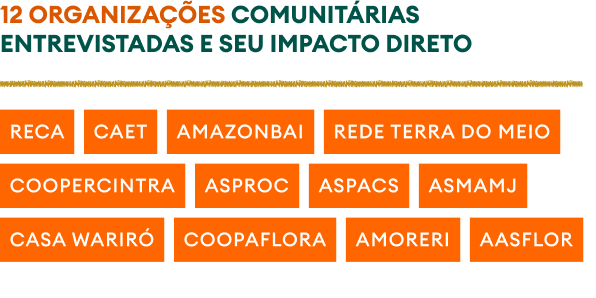
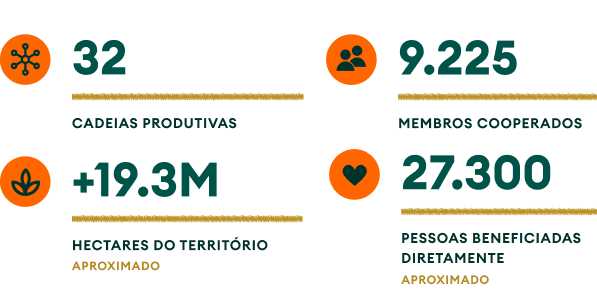
Twelve leading community organizations working in socio-biodiversity production chains across an area of influence of 19.3 million hectares were consulted. The Amazon map aims to ensure diversity and territorial, sectoral, and developmental stage representativeness, offering a perspective from different realities of the Amazonian socio-bioeconomy.

Technical and structural challenges
This first stage of the study gathered insights from 12 community organizations to identify the main structural challenges of the Amazonian socio-bioeconomy.
The results were organized into 12 critical points , which reveal recurring patterns in the production chains and support relationships of the ecosystem.
Each point reflects a dimension of vulnerability, but also an opportunity for collective action for facilitators, funders, and policymakers.
Technical and structural challenges

PHILANTHROPY
Even with increasing connectivity, solutions remain piecemeal and poorly adapted to local realities.
Diffuse support
The lack of specialization makes the support generic, limiting the resolution of complex problems.
INFRASTRUCTURE AND LOGISTICS
Poor logistics and physical infrastructure limit access to markets and keep costs high.
Institutional and management challenges

GOVERNANCE AND TEAM
Lack of technical staff and overburdened leadership compromise the continuity of operations.
FINANCE AND WORKING CAPITAL
The lack of personal resources and the fear of debt restrict investments and planning.
SUCCESSION AND YOUTH
The low attractiveness of productive activities and the lack of training opportunities discourage the renewal of leadership.
Production and marketing challenges

LOCAL INDUSTRIALIZATION
The lack of professionals, energy, and equipment limits processing and value addition.
MARKETING
Cooperatives prioritize B2B models to ensure stability, but lack market diversification strategies.
SUSTAINABLE GROWTH
It is necessary to balance productive expansion with respect for the timing of management practices and local traditions.
Social and systemic challenges

FUNCTIONAL OVERLOAD
Leaders juggle productive, administrative, and domestic responsibilities, reducing the time available for innovation.
A DIGNIFIED LIFE
Priorities remain focused on collective well-being, highlighting basic social needs in the territories.
INVESTMENT AND CREDIT
Lack of adequate financial instruments and fear of debt hinder productive progress.
The interpretations above were constructed from interviews and qualitative analyses.
In parallel, the network mapping developed in this stage revealed 110 actors, 406 connections, and new patterns, gaps, and recurrences in the connections between community organizations, as providers of green solutions, facilitators, and demanders of green solutions.
These maps show how the ecosystem is organized in practice – where relationships are strong, where coordination is lacking, and where support is concentrated in a few actors.
The combination of listening and network analysis offers an integrated view of the system, pointing the way to more coordinated and structured actions.
Map of actors and types of support
With a categorized view of the actors and existing relationships, the map below presents relationship patterns and partner types.
The relationships identified were categorized as:
It typically involves long-term partnerships, mutual trust, and shared responsibility in key decisions or processes.
• Recurring: This is a frequent, but operational relationship, in which there are regular and continuous exchanges, without necessarily involving joint strategic decisions.
• One-off: This is a relationship in which the organization acts as a supplier of products or services, and the other party purchases them – this could be the end consumer, a store, a distributor, a company, or the government.
• Client: This is the relationship in which the organization acts as a supplier of products or services and the other party buys them – this could be the end consumer, a store, a distributor, a company, or the government.
This combination of data allows us to visualize:
• Distribution of power and centrality – which actors concentrate connections and occupy a strategic position in the network;
• Different relationship patterns – predominance of financial relationships, lack of recurring support regarding the stability and continuity of partnerships;
• Balance between the supply and demand for support – who provides support, who is supported, and which actors are involved in this process, among different groups.
Map of institutional roles in the network.
This map presents the 110 actors, cited as members of the networks of community organizations, organized by categories of institutional roles. Each group brings together the cited organizations that perform these roles in the Amazonian bioeconomy ecosystem.
The institutional roles were determined based on the Climate Ventures mandala:
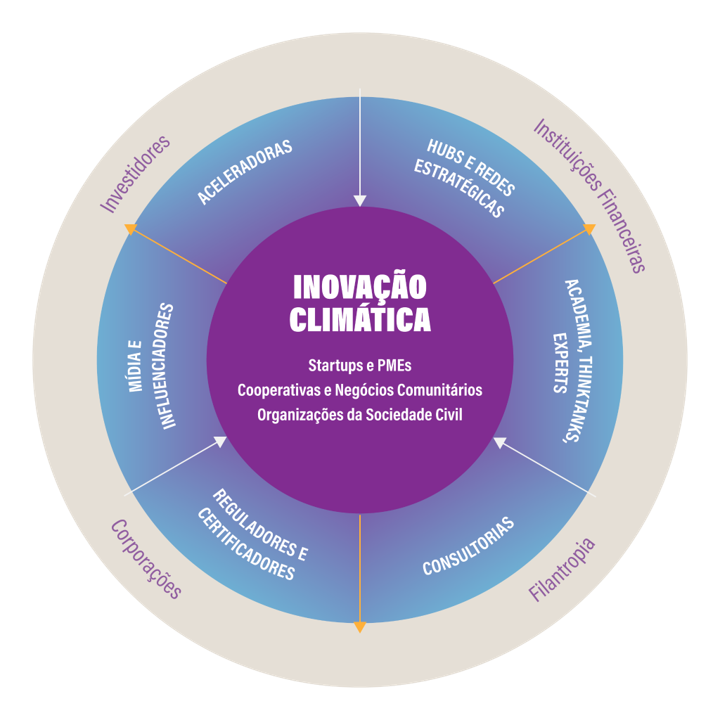
This representation allows us to observe:
• Density of activity and coordination: areas of greater density of activity and coordination.
• Less frequently mentioned roles and actors: gaps in presence or integration in certain roles.
Map Partnerships and scopes of collaboration
In this visualization, we advance in qualifying the relationships presented that typify the scopes of the listed partnerships. This visualization helps to understand the areas with the highest density of cooperation and which actors are responsible for such support offers. We visualize:
• recurring and diversified partnerships – indicate areas and actors with greater coordination and an established flow of solutions;
• Infrequent or absent partnerships – highlight gaps or opportunities to strengthen ties within the ecosystem.
Map of the Building Blocks of the Socio-bioeconomy Ecosystem Model of the Brazilian Amazon 2024
The map shows how the building blocks of the 2024 Socio-bioeconomic Ecosystem Model of the Brazilian Amazon connect to the different actors who play institutional roles associated with each of them.
The analysis allows for the identification of blocks with the highest density of connections—where there is a concentration of actors and a strong incidence—and, in contrast, the peripheral blocks, with less integration, indicating areas that demand greater attention and investment.
Meet the 12 organizations interviewed.
RECESS
EST. 1989 – Porto Velho, RO / Ponta do Abunã Region
RECA (Reflorestamento Econômico Consorciado e Adensado - Economic, Consorted and Dense Reforestation) is a pioneering initiative, founded in 1989, located in the Ponta do Abunã region of Rondônia. The organization stands out for its large-scale implementation of Agroforestry Systems (SAFs), involving hundreds of farming families in a model that integrates diversified production, value aggregation, and environmental conservation.
Priority Production Chains: Pineapple, Acerola, Andiroba, Coffee, Brazil nut, Copaiba, Cupuaçu, Guava, Soursop, Passion fruit, Honey, Peach palm, Agroforestry Systems, Seeds
Pain Points by Block of the Amazonian Sociobioeconomy Ecosystem Model: [03] Decision-Making Levels, [04] Collective land use and territorial rights of PIQCTs, [09] Sociobioeconomy Production Processes, [12] Innovation and Support Ecosystem, [13] Initial Transport, [14] Intermediate and Primary Supply Networks
Area in hectares (approximate): 5200
People directly benefited (number of cooperative members × 4): 1,200
Number of members: 300


LET'S GO
EST. 2001 – Tarauacá, AC / Municipalities of Tarauacá, Feijó and Jordão
The Tarauacá Agro-extractive Cooperative (CAET) is an organization with approximately 410 members, located in the state of Acre and operating in the municipalities of Tarauacá, Feijó, and Jordão.
Priority Production Chains: Babassu, Brazil Nuts, Fishing, Seeds
Pain Points by Block of the Amazonian Sociobioeconomy Ecosystem Model: [05] Types of Financing, [08] Educational and Training Institutions, [09] Sociobioeconomy Production Processes, [11] Capacity Building, [12] Innovation and Support Ecosystem, [13] Initial Transportation, [14] Intermediate and Primary Supply Networks, [15] Market Choice
Area in hectares (approximate): 154,134
People directly benefited (number of cooperative members × 4): 1,640
Number of members: 410
Amazonbai
Est. 2018 – Macapá, AP
A cooperative of native açaí extractive producers in Amapá, composed of 150 members. Focus on vertical integration of production and access to high value-added markets.
Priority Production Chains: Açaí, Honey
Pain Points by Block of the Amazonian Sociobioeconomy Ecosystem Model: [09] Sociobioeconomy Production Processes, [11] Capacity Building, [12] Innovation and Support Ecosystem, [13] Initial Transport, [14] Intermediate and Primary Supply Networks, [15] Market Choice
Area in hectares (approximate): 2,972
People directly benefited (number of cooperative members × 4): 600
Number of members: 150
Terra do Meio Network
EST. 2009 – Altamira, PA / Middle Land
An association that brings together indigenous peoples, riverside communities, and family farmers across a vast territory in the Altamira region of Pará.
Priority Production Chains: Handicrafts, Babassu, Brazil nuts, Cassava, Murumuru, Seeds
Pain Points by Block of the Amazonian Sociobioeconomy Ecosystem Model: [09] Sociobioeconomy Production Processes, [12] Innovation and Support Ecosystem, [13] Initial Transport, [14] Intermediate and Primary Supply Networks, [15] Market Choice
Area in hectares (approximate): 7,000,000
People directly benefited (number of cooperative members × 4): 12,000
Number of members: 3,000
COOPERCINTRA
EST. 2011 – Juruá Valley (AC and AM)
The Cooperative of Agro-extractive Producers of the Juruá Valley, founded in 2011, operates in the production of murumuru butter and native rubber.
Priority Production Chains: Rubber, Murumuru
Pain Points by Block of the Amazonian Sociobioeconomy Ecosystem Model: [04] Collective land use and territorial rights of PIQCTs, [07] Rural-Urban Connection, [08] Education and Training Institutions, [09] Production Processes, [11] Capacity Building, [12] Innovation and Support Ecosystem, [13] Initial Transport, [14] Primary Supply Networks, [15] Market Choice
Area in hectares (approximate): 824,901
People directly benefited (number of cooperative members × 4): 1,644
Number of members: 411
ASPROC
EST. 1994 – Carauari, AM / Middle Juruá, Amazonas
The Association of Rural Producers of Carauari, founded in 1994, operates within the territory of the Uacari Sustainable Development Reserve and the Médio Juruá Extractive Reserve.
Priority Production Chains: Andiroba, Açaí, Rubber, Copaiba, Fishing, Pirarucu
Pain Points by Block of the Amazonian Sociobioeconomy Ecosystem Model: [09] Sociobioeconomy Production Processes, [11] Capacity Building, [12] Innovation and Support Ecosystem, [13] Initial Transport, [14] Intermediate Supply Networks, [15] Market Choice
Area in hectares (approximate): 632,949
People directly benefited (number of cooperative members × 4): 3,200
Number of members: 3,200
ASPACS
EST. 1997 – Lábrea, AM / Ituxi Extractive Reserve, Middle Purus, Canutama State Forest
A community-based association founded in 1997 in Lábrea (AM), led by women and active in riverside and indigenous communities.
Priority Production Chains: Andiroba, Brazil nut, Cassava, Murumuru, Mutamba, Tucumã
Pain Points by Block of the Amazonian Sociobioeconomy Ecosystem Model: [02] Actors, [05] Types of Financing, [11] Capacity Building, [12] Innovation and Support Ecosystem, [13] Initial Transport
Area in hectares (approximate): 604,290
People directly benefited (number of cooperative members × 4): 920
Number of members: 230
ASMAMJ
EST. 2004 – Carauari, AM / Middle Juruá, Amazonas
Association of Agro-extractive Women of the Middle Juruá, founded in 2004. Works with biocosmetics and bio-jewelry.
Priority Production Chains: Andiroba, Copaiba, Mutamba
Pain Points by Block of the Amazonian Sociobioeconomy Ecosystem Model: [05] Types of Financing, [09] Production Processes, [11] Capacity Building, [13] Initial Transport, [14] Intermediary Networks
Area in hectares (approximate): 286,955
People directly benefited (number of cooperative members × 4): 1,152
Number of members: 288
Wariró House
EST. 2006 – São Gabriel da Cachoeira and Japurá, AM / Upper Rio Negro, Amazonas
A collective brand of FOIRN representing the production of 23 peoples of the Rio Negro region. Collective management based on "good living".
Priority Production Chains: Pineapple, Handicrafts, Banana, Uará Brazil Nut, Cubiu (a type of fruit), Cassava, Tucumã (a type of palm fruit), Tucupi (a type of sauce), Tourism
Pain Points by Block of the Amazonian Sociobioeconomy Ecosystem Model: [05] Types of Financing, [07] Rural–Urban Connection, [11] Capacity Building, [12] Innovation and Support Ecosystem, [13] Initial Transport, [14] Primary Networks
Area in hectares (approximate): 10,091,713
People directly benefited (number of cooperative members × 4): 4,000
Number of members: 1,000
COOPAFLORA
EST. 2019 – Oriximiná, PA / Lower Amazon, Pará
Mixed Cooperative of Traditional Peoples and Communities of the Northern Coast, founded in 2019.
Priority Production Chains: Andiroba, Brazil nut, Copaiba, Cumaru, Pepper
Pain Points by Block of the Amazonian Sociobioeconomy Ecosystem Model: [05] Types of Financing, [09] Production Processes, [11] Capacity Building, [12] Innovation and Support Ecosystem, [13] Initial Transport, [14] Intermediary Networks
Area in hectares (approximate): 4,000,000
People directly benefited (number of cooperative members x 4): 688
Number of members: 172
To Amore
EST. 2006 – Altamira, PA / Rio Novo, Iriri River Extractive Reserve, Pará
The Rio Novo Residents' Association, located in the Rio Iriri Extractive Reserve, Pará, is involved in the processing of Brazil nuts and babassu palm.
Priority Production Chains: Babassu, Brazil Nuts, Fishing, Seeds
Pain Points by Block of the Amazonian Sociobioeconomy Ecosystem Model: [02] Actors, [09] Production Processes, [11] Capacity Building, [12] Innovation and Support Ecosystem, [13] Initial Transport
Area in hectares (approximate): 398,993
People directly benefited (number of cooperative members × 4): 128
Number of members: 32
AASFLOR
EST. 2011 – Uruará, PA / Microregion of Altamira, Pará
The Sementes da Floresta Administrative Association, founded in 2011, is located in Uruará (PA).
Priority Production Chains: Andiroba, Babaçu, Breu Branco, Brazil nut, Copaiba, Cumaru, Cupuaçu, Cassava, Agroforestry Systems, Seeds, Ucuuba
Pain Points by Block of the Amazonian Sociobioeconomy Ecosystem Model: [05] Types of Financing, [09] Production Processes, [12] Innovation and Support Ecosystem, [13] Initial Transport, [14] Intermediary Networks
Area in hectares (approximate): 3,200
People directly benefited (number of cooperative members x 4): 128
Number of members: 32
 Join the Green Transformation
Download the partial report of the Sociobioeconomy Community Connections Map in the Amazon 2025
Technical sheet

Daniel Contrucci
Richard Gravina
Out Lottfi
Climate Ventures
Climate and Land Use Alliance – CLUA
Osmarino de Souza
Adevaldo Dias
Rosângela Cunha
Luana Leite
Sandra Barros
Luciane Tariana
Amiraldo Enuns de Lima Picanço
José Santiago
Daiana da Silva
Silvio Porto
Francisco de Assis Porto de Oliveira
Raimunda Rodrigues
Erismar Saouza
Hamilton Condack
José Rodrigues de Araújo
Climate Ventures & BioDiversas Lab
Whilla Castelhano
Christian Brito
BioDivers Lab
Climate Ventures
Luiz Teodoro
Syntropics
Our Partners
We work in collaboration with organizations and institutions committed to the climate agenda and sustainable development, including:

These partners play a crucial role in the development and implementation of the solutions and analytics presented by OV Insights.