Structuring the Nature-Based Solutions (NbS) market in Brazil

Brazil holds a rare combination of assets and is experiencing a decisive moment for Nature-Based Solutions (NbS). With capital already mobilized, the challenge has changed: beyond attracting resources, the focus is now on ensuring pipeline readiness, execution capacity, and market infrastructure.

Explorar Imgem destacada
Map of segments, bottlenecks, and levers.

From opportunity to market logic

Executive Summary

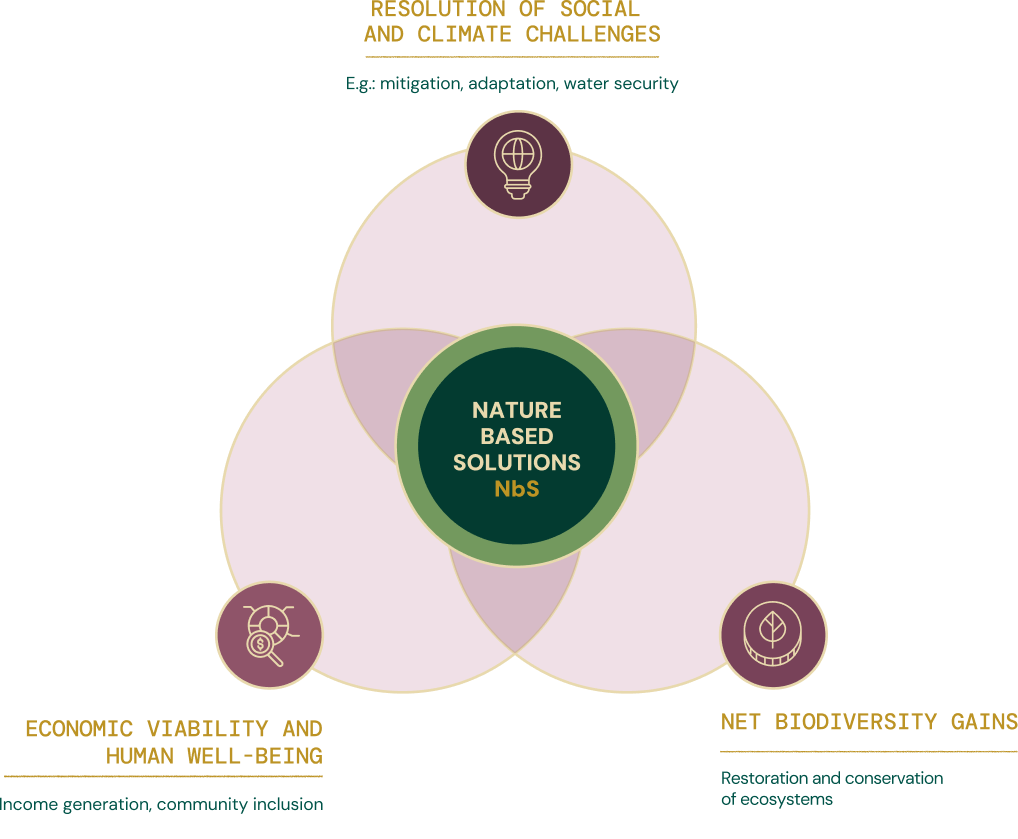
For the nature economy to scale, Nature-Based Solutions (NbS) must be understood beyond a purely environmental agenda. In this study, NbS represents the intersection where solutions to climate and social challenges converge with net biodiversity.

Access the portuguese version here

The central problem is now organizing the conditions for this market to scale with integrity; there is no longer a need to prove that NbS matters.”

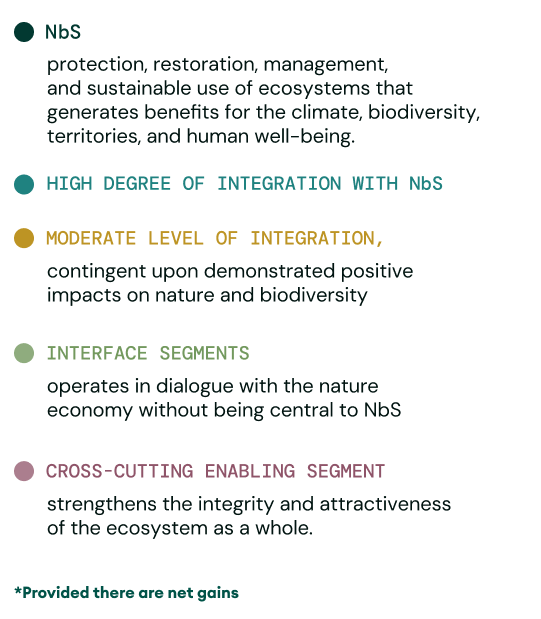
Nature-based solutions (NbS)

By definition, this study considers that nature-based solutions primarily offer solutions to social and climate challenges, net gains in biodiversity, economic options, and human well-being.


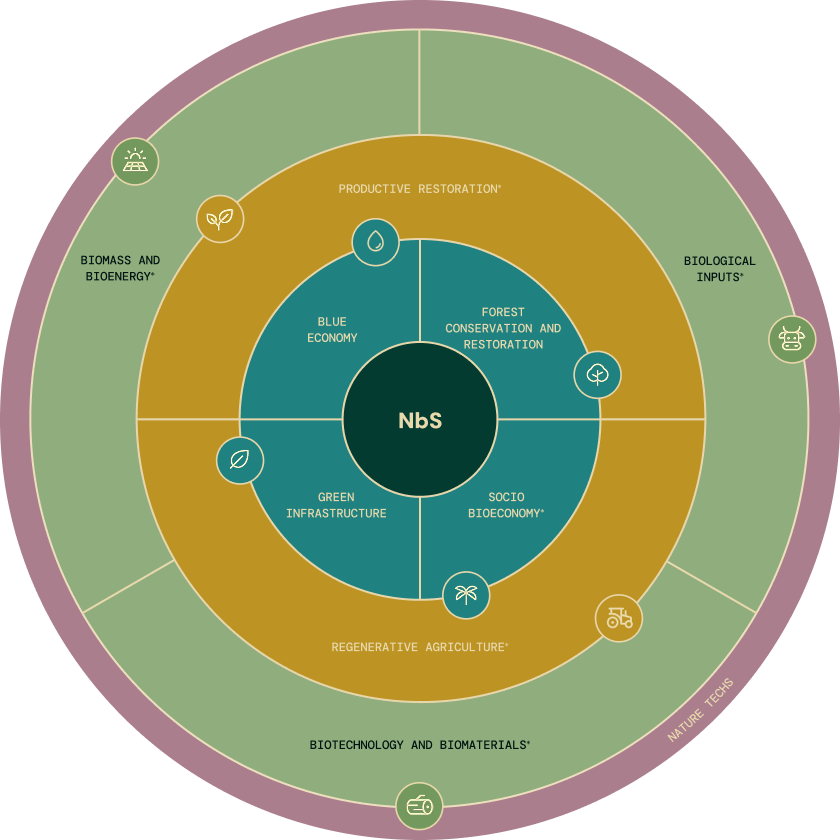
The market anatomy in 10 strategic segments

The 10 segments do not operate in silos. Data qualifies the pipeline. The pipeline connects to capital. Capital enables territorial implementation. Demand, anchored in public policy, builds predictability and scale.

A restoration project, a sociobioeconomy cooperative, and a nature tech company will not access capital through the same route. Reading the market as a single asset class reduces the efficiency of every allocation decision.

What does the ecosystem reveal?

An invitation to interactive exploration (tools and data)

So that the intelligence of this mapping wouldn’t be restricted to static spreadsheets, we transformed the market information into two dynamic tools: an affinity network (graph) and an analytical panel (dashboard). We invite you to interact with the data and dive into the specifics of segments, biomes, and roles.

The Network (graph): mapping affinities

Explore the connection of 2,177 organizations mapped not by commercial partnerships, but by thematic affinities and shared purposes. The colors indicate the strategic segment, while the geometric shapes reveal the actor’s role in the market: circles for solution providers (ofertantes), squares for funders (financiadores), and triangles for enablers (dinamizadores).

Navigation tip: double-click any organization to activate “focus mode” and isolate its immediate network of connections.


Analytical dashboard: crossing variables

Use our interactive exploration center to apply combined filters and create tailored analyses. Navigate through the thematic tabs (“Overview”, “NbS Anatomy”, and “Cross-references”) and use the side menu to cross-reference information by biomes of operation, detailed roles, and specific markers (tags).

Navigation tip: This view is optimized for desktop and tablet.


Strategic highlights: What will you discover?

By exploring the tools above, the data reveals a high interdependence within the ecosystem and brings crucial sector patterns to light:

1

Traction and transversality

Three segments account for the largest share of the ecosystem: Forest Conservation, Nature Techs, and Green Infrastructure. This reflects areas with already established traction in ecological assets, as well as the technologies (such as Nature Techs) that provide the digital infrastructure enabling the broader ecosystem.

2

The mismatch of roles

The tools expose a structural bottleneck: there is an abundance of solution providers on the ground, but a severe shortage of funders and territorial enablers. Without these articulators, initiatives cannot access capital.

3

Innovation in capital flow

The long biological cycles and risks of NbS demand financial innovations. Capital flow shows the leading role of investors using blended finance and patient capital to make the market viable.

4

Irregular maturity across the territory

The biome map reflects an underrepresentation of the Coastal and Marine Zone. The Blue Economy in Brazil still faces regulatory challenges and a lack of structured pipeline to attract venture capital.

5

Territorial anchoring

Within the Sociobioeconomy, the high proportion of cooperatives and community-based enterprises demonstrates that the scale that the scale of this segment inherently depends on strengthening local organizations and community governance.

Leverage points: pathways to structure the market

The sector’s main hurdles no longer stem solely from a lack of projects, but from the absence of an infrastructure capable of connecting assets, segments, capital, data, territory, and demand. To unlock this scenario, the study proposes systemic interventions structured across five complementary fronts:

Imagem de capa da publicação National pipeline infrastructure
National pipeline infrastructure

The main gap today is the lack of a legible pipeline. Minimum standards must be established and assets made comparable to facilitate risk assessment and connections to capital.

Imagem de capa da publicação Territorial implementation platforms
Territorial implementation platforms

Scale does not emerge solely from individual projects, but from local arrangements (like BioHubs) capable of articulating governance, technical assistance, processing, and financing within the same territorial base.

Imagem de capa da publicação Financial innovation and patient capital
Financial innovation and patient capital

Standardized solutions fail in the face of long biological cycles. The next phase will require financial architectures that combine grants, catalytic capital, flexible debt, and blended finance to align risk and return with nature’s conditions.

Imagem de capa da publicação Data and integrity
Data and integrity

The value of NbS depends on attributes that must be verified (such as carbon, origin, and biodiversity). Traceability and robust monitoring systems (MRV) are not just technical support, but central conditions for ensuring trust and bankability.

Imagem de capa da publicação Public policy and demand induction)
Public policy and demand induction)

No market scales through supply alone. The State and corporate buyers must help induce demand through public procurement, credit lines, and long-term contracts (like offtake agreements) to provide revenue predictability for projects.

The ecosystem in motion: who is already building this market

The Brazilian Nature-Based Solutions market is not starting from scratch. In recent years, a robust intermediary layer of coalitions, platforms, funds, territorial organizations, and financial institutions has formed, already playing a decisive role in structuring the ecosystem. The study identifies these structures across four fronts of action:

Financial coordination

Organizations that produce market intelligence, structure blended finance solutions, and operate induction programs to reduce risks and connect assets with compatible capital.

Institutional organization and milestones

Initiatives focused on establishing eligibility criteria, shared languages (such as taxonomies), and connecting NbS to planning instruments and public policy frameworks.

Territorial capacity

Enablers operating on the ground with technical assistance, strengthening of community businesses, local governance, and articulation of socio-biodiversity chains.

Technology, data, and integrity

The new generation of platforms (Nature Techs) aimed at traceability, MRV, geointelligence, and compliance, which are essential for transforming socio-environmental value into comparable and bankable assets.

Participate in structuring this market

Structuring the Nature-Based Solutions (NbS) market in Brazil

Brazil can go beyond simply participating in the global Nature-Based Solutions market – we can help define it. Download the complete study, explore the interactive tools, and discover the connections that will drive your next strategic move.

Full report will be available soon.

Team

GENERAL COORDINATION

Daniel Contrucci

Laura Fostinone

Ude Lottfi

TECHNICAL TEAM – CLIMATE VENTURES

Laura Fostinone

Daniel Contrucci

Ude Lottfi

Fabiana Philippi

Heloisa Garcia

Maria Eugênia Buosi

Vitor Salomao

TECHNICAL TEAM – EXTERNAL

Queries and Code – Rafael Pereira

Indense – Luiz Bouabci

Juliana Baladelli Ribeiro – Fundação Grupo Boticário

Guilherme Karam – Fundação Grupo Boticário

TEXT EDITING AND PROOFREADING

Luiz Teodoro

RevisoLab

Gabriela Rocha

COMMUNICATION AND DESIGN

Climate Ventures

Amanda Custodio

Sintrópika

Our Partners

We work in collaboration with organizations and institutions committed to the climate agenda and sustainable development, including:


These partners play a crucial role in the development and implementation of the solutions and analyses presented by OV Insights.